Blog

Dispatch from Vermont: On Hubert Butler, Local Histories, and Places of Identity Formation

Last week, I took a five-day trip with my family to Vermont. This was my first time in the state and my first extended “travel” since moving to New York City in January.

Vermont was a refreshing detour for me. After seven months in Manhattan, it was good to retreat to a state with lots of green mountains but not a single billboard, and whose largest city has fewer than 50,000 residents.

What I enjoyed most in Vermont was experiencing the many hints of local pride, which were rooted in a very specific but deep history. From listening to a long-winded but impassioned brewery tour guide to coming across an intricate alleyway mural chronicling the centuries-long story of Burlington’s Church Street Marketplace, I got an impression that Vermonters truly had a sense of ownership of their home state.

During one of our evenings off, I skimmed through an essay anthology I found on a bookshelf in our rental home and stumbled across a piece by the late Hubert Butler, an Irish essayist. He writes in the essay “Beside the Nore”:

I have always believed that local history is more important than national history… Where life is fully and consciously lived in our own neighborhood, we are cushioned a little from the impact of great far-off events which should be only of marginal concern to us.

Many people — myself included — move to places such as New York or Los Angeles to, at least in part, “find ourselves.” And while these journeys of identity creation may be rewarding, my brief time in Vermont has reminded me to appreciate the other neighborhoods that have formed me and my family — a blue-collar suburb in New Jersey, a mountain village in central Taiwan, a coastal town in Southern China — places with richer stories than their seemingly unassuming natures might suggest.


Tim’s Recommendations

Postcards from Taiwan, no. 4: Childhood Journeys and Alternate Realities in Taichung

Screen Shot 2015-01-02 at 9.35.39 AM

Greater Taichung (pop. 2.6 million) is where my mom spent her childhood, and where her family has lived for generations. Over two nights and two days, we visit dozens of relatives – cousins, 2nd cousins, my grandpa’s sister, a few I know by face, fewer I know by name – for tea or for fruit in their homes, for dinner at local restaurants.

Day 1: Da Nan Village – Mom’s birthplace and childhood home

On Wednesday morning, we visit a woman I know as Huang Ah-Yi, my mom’s childhood best friend and next-door neighbor. I first met Huang Ah-Yi during her visits to the US, first when I was ~4 and again about 3 years ago. She lives a five-minute drive away from Da Nan village, where her elderly mother still lives next door to the house my mom did growing up.

Huang Ah-Yi is an award-winning horticulturalist. She gives us a tour of her greenhouse, replete even in January with row after row of flowers, organic vegetables, herbs, and shrubbery. Then she takes the five of us inside for tea. As Huang Ah-Yi and my mom chat, I think of alternate realities, and wonder how their life trajectories would’ve differed had my mom stayed in Taiwan, or had Huang Ah-Yi come to America.


It’s breezy and ~60 degrees outside. We make the short drive to Da Nan, which sits in the hills of Xinshe District on the outskirts of Taichung. We pay a brief visit to greet Huang Ah-Yi’s mom, then walk around the neighborhood, past villagers tending a small community garden, and wooden, Japanese-style houses. They were built for Taiwanese locals, including my Ah-Gong (grandpa), who was employed by the Seed Improvement and Propagation Station, under the agricultural bureau of the Japanese government in Formosa.

As we turn a street corner, Huang Ah-Yi points at some towels and t-shirts hanging out to dry on a clothesline. “Your mom and I used to hide and play there when we were little,” she says. Underneath, I see a locked metal door. It leads to what used to be a bomb shelter during World War II.

Finally, we reach a small, wooded park with a small memorial in the corner. Ah-Ma and Ah-Gong were married here in early 1945. She was 21; he was 24. The memorial was originally Shinto shrine, but the text of the stone monument in the center has been painted over, and now commemorates the return of Taiwan from Japan to the Republic of China.


Day 2: Chung Hsing New Village and Nantou County – Mom’s home after middle school

On Thursday, my cousin takes us to Nantou County, where we visit the 921 Earthquake Museum of Taiwan. At 1:47am on September 21, 1999, an earthquake measuring 7.3 on the Richter scale shook the island of Taiwan, killing 2,415 people and injuring over 11,305. The damage was worst in Taichung and Nantou County, where a fault line runs past Ah-Ma’s house.

At the time, Ah-Ma was staying with us in New Jersey, where it was early afternoon. When my mom heard the news, she told me and my brother to distract Ah-Ma and keep her from turning on the TV. My mom was able to reach all of our relatives in Taiwan and confirm they were OK before she told Ah-Ma what had happened. I remember sitting in her room as she watched the news coverage, often in tears, for many days later.


1999 was also the last time I visited Ah-ma’s house, 7 months before the 921 earthquake. I was 9 years old. Since my mom was in middle school, Ah-Ma and Ah-Gong lived in Chung Hsing New Village, Nantou County (pop. 25,000), which also serves as the provincial capital of Taiwan (ROC). We drive through the village gate, lined with palm trees on the side and a row of Taiwanese flags on top.

Memories start flooding back to me as soon as we pull up to Ah-Ma’s house, which has been uninhabited since she died 3 years ago: the laundry once hanging in the front yard, the lime green tiles of the front step that continue into the house, a lone osmanthus shrub whose scent I’d recognized in Hualien.

Then more memories: riding a bike around the cul-de-sac with my cousins when I was 7 (and crashing it), watching Pinocchio for the first time (it was Mandarin-dubbed), eating Domino’s pizza, hiding from the stray dogs that shared the neighborhood. As my parents, my brother, and my cousin head back to the car, content with the photos they’d taken, I sit and linger on the front step, savoring the brief journey back to my childhood.


More from Taiwan:

Part 3: Wanderlust and Introspection in Taitung and Kaohsiung
Part 2: The Hualien I Will Remember
Part 1: Disorientation and Jetlag in Taipei

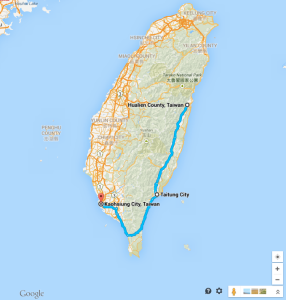
Postcards from Taiwan, no. 3: Wanderlust and Introspection in Taitung and Kaohsiung

Screen Shot 2014-12-31 at 12.37.02 PM

On a cloudy Monday, we take a cab and head south through Hualien County toward Taitung. The roads are lined with taro fields, rice fields, and fields with banana, pineapple, and papaya trees, like my mom’s childhood hometown once was. “This is the last non-industrialized part of Taiwan,” our driver tells us.

He turns a typically three-hour long drive into a full day’s journey, taking us to Liyu Lake, Yun Shan Shui, and Brown’s Road – previously obscure landmarks now overrun with tourists like us. “It’s like a night market now,” our driver says of Yun Shan Shui, a dream-like lake in Shoufeng. He drops us off in Taitung, where we stay the night.

Tuesday greets us with the first sunny day of our trip – 70°F in December – and so I go for a morning run, first through the courtyard of a museum, then through the outskirts of Taitung.

On Tuesday afternoon, we head from Taitung to Kaohsiung (pop. 2.8 million), the home of a major seaport, and my Gandie‘s (godfather’s) hometown. On the train, I make progress on reading Lauren Hillenbrand’s Unbroken (a Christmas gift from my friend Greg), the story of Olympic runner and World War II airman Louis Zamperini.

As I read Unbroken, the train runs along the ocean and weaves through coastal towns. Taiwan was a Japanese Colony during the War, the site of several Japanese military bases and multiple U.S. bombing raids. I look out the train window at the gentle waves of the Pacific, finding it hard to believe that the war was unfolding here just two generations ago.

We get to Kaohsiung and I’m in my element, navigating us through public transit and city streets. We explore the Pier-2 Art Center, where industrial warehouses have been converted into colorful galleries, then take a short ferry ride to Cijin Island to watch the sunset from the granite-colored beach.

My brother and my parents are ready to call it a night after dinner, at least travel-wise. “It’s only 7:30!” I protest to no avail. Relaxation stresses me out, so I wander through Kaohsiung alone, weaving through mopeds on the street and learning the subway system. I find myself at a night market, which is buzzing on a Tuesday night with locals and tourists from Hong Kong and Japan.

I slip back into the hotel as the subway closes for the evening and deliver a midnight snack of fried chicken bites and tiramisu.

Postcards from Taiwan, no. 2: The Hualien I Will Remember

It’s raining when we arrive in Ji’an, Hualien County late Saturday afternoon, after a 3-hour train ride from Taipei. When we arrive, I notice a sweet but tenacious fragrance that transports me back 15 years to Ah-Ma’s front yard in Nantou. My mom tells me the fragrance is from the white osmanthus flowers outside our door.

We walk around Ji’an, which is covered with fields of taro leaves shooting above the water, and surrounded by green mountains covered with wisps of clouds. It reminds my mom of her childhood village.


On Sunday, we visit Taroko National Park. Here, the powerful Liwu River carved a deep gorge into the marble cliffs of the Central Mountain Range. It’s the home of the Taroko tribe, one of many aboriginal groups who inhabited the island for thousands of years before my mother’s ancestors came 400 years ago.

We follow behind dozens of tourists, who are armed with iPads, smartphones, and selfie sticks, all wearing sky blue helmets to protect from falling rocks. At the Chingshui Cliffs, I catch my first glimpse of the Pacific, resplendent in turquoise even on a rainy day.


It’s early Monday morning in Ji’an. I slip out of bed and into my Saucony running shoes, reenacting my DC running ritual. I follow a bike path heading out of town, past grazing water buffalo, through taro fields, then along a rapid stream carrying water from the mountains.

This is the Hualien I will remember – scenes and scents no iPhone photos or Insta-poetry of mine can capture, just the asphalt under my feet, my lungs drunk on the humid air as I miss the final turn on the way home.

Postcards from Taiwan, no. 1: (Dis)Orientation in Taipei

It’s Saturday morning in Taipei, and after a 15-hour flight, it feels funny to eat breakfast and still have a full day still ahead of us.

We’re hanging out at my cousin’s apartment. My dad and my brother nap on the living room couch as a Grizzlies-Rockies game airs on TV. My mom chats excitedly with my cousin in the back room. She’s our family’s connection to Taiwan, where she spent her first 22 years before graduate school in New Jersey, where she met my dad—who was also an international student at the time, from Hong Kong.

As a kid, I learned about Taiwan from afar. I was obsessed with maps, and I thought Taiwan looked kind of like New Jersey, except without a belt around her waist. I would also repeat after my mom aloud when she spoke on the phone with my grandmother—or Ah-Ma—in Hokkien.

We visited Ah-Ma in Nantou County a couple of times when my brother and I were little. Now she’s gone. It feels funny to be back in Taiwan, to be here on vacation in my mother’s homeland, though she herself has never seen most of the places we’re going to visit.

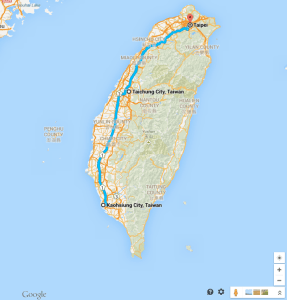
It’s a rainy morning in Taipei. We follow my cousin through a temple, then through a series of subway trains. He leaves us at Taipei’s central transit hub, where we board a train headed southward, toward a Taiwan my mother didn’t know.